Aug 24, 2008

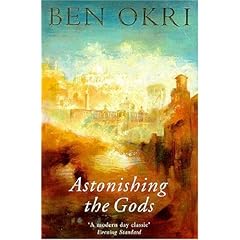
Review of Ben Okri's "Astonishing The Gods"

Fables carry many luxuriant treasures for the ears and eyes. This is why we find solace in them. As children we sojourned comfortably in our beds, immersed in the fables our parents read to us amongst the soft lamplight. As adults the residue from these stories still subtly modulates within us. Only now we have the ability to weave our own lives into the fables and, if we are paying close enough attention, the fables will imitate our lives by putting a mirror up to them.

African writer Ben Okri creates spellbinding fables that are timeless in execution and accessible for people of varying age groups. And indeed his stories hold up the mirror of self-discovery. Maybe his aptitude in creating engulfing tales came from listening to his grandmother, grandfather, mother, and father talk about the ups and downs of Africa’s ancestry? My guess is that he listened attentively, but fine-tuned these stories when he found a deeper spectrum of his own self. Quite clearly in Astonishing The Gods, Okri writes from a place of profundity where the literary dynasties of myth and redemption come to play.

Right from the get go, Okri entrances the reader with a stylistic prose that hums melodiously and magnificently. He expounds that a nameless man--a man who is search of visibility--is on a quest with a hard to pin down destination. An ominous-yet-placid feeling surrounds each word after this point, and much to Okri’s skill in painting with language, the reader is swept away with each emotive stroke. Wandering through lands filled with contradictions and etheric vibrations, cautiously walking over an alchemical bridge shape-shifting to his oscillating moods, listening to the whimsical and wise sermons of unseen guides, Okri’s nameless character moves through the destination-less journey with every nuance of his soul taking note. You could say the nameless character is doing some astounding research in a sabbatical that we all have a difficult time comprehending: the exploration of the brain-soul complex. This is why I would say Okri writes about the human position in a universe shrouded in shadow and illumination.

Not only should you read this book to peer into an unsung classic of contemporary literature, you should read this book to peer into the glutinous fluid of passion that galvanizes your own being. This way you could harvest all the ideas the novelist has to offer and, in exchange, plant memes in your own creations of darkness, beauty, lightness, and revelation. After all, I am sure all an author like Ben Okri wants to do is unfetter the mind’s tangled wings so they can fly to their rightful place in the heavens.

Chicago Journal Fragments

Somewhere between Winnipeg and Fargo:

Suspended between the realm of non-being and being, clouds effortlessly roam the great cerulean pool in search of other clouds, other flimsy formations that know nothing but a condensed state of openness. The same can be said of thoughts.

Minneapolis Bus Depot:

Looking at copious amounts of crumbled concrete that is cleverly piled to resemble a mountain range of post-apocalytpic excrement.

Poem:

Every citizen is an illumined star
that intuits the message of the toenail moon,
and yet the Walls persist.
What alienates all our stubborn hearts?


Aug 10, 2008

Chicago Journal Fragment #1

I bought a book in downtown Chicago today. It's called, "Zen Poems of China and Japan". I highly enjoy the succinct and profound nature of this collection. Here is one by Choro:

With one foot on the brick step,
The All burst into my head.
I had a good laugh by
The box tree, moon in the bluest sky.

These early Zen writers certainly knew how to shove a satori into a walnut, and then another satori into a walnut shard. Here are my Zen meditations on Chicago:

Intersecting streets
all breathing like fallen stalks
Nothing is contained in this traffic noise
All things, from the start, are unknowable, Void.

and

Up above the highest towers
an unseen belly roars
Flash! Light!
The world is gobbled up before hunger sets in.

King Crimson At the Park West

Set List:

Drum Intro.
The Construction of Light
Frame By Frame
Red
Neurotica
Three of a Perfect Pair
VROOOM
Coda: Marine 475
One Time
B'Boom
Dinosaur
Level Five
Larks Tongues in Aspic

Drum intro.
Thelma Hun Ginjeet
Sleepless
Indiscipline
Elephant Talk

King Crimson thoroughly rocked the Park West Theatre. Every moment was a lesson in R-O-C-K---how it should be played with consummate precision, cerebral ingenuity, and abstruse time signatures. The set started off with a thunderous drum onslaught that slithered well into the inordinately complex, "The Construction of Light". Then one of the standout tracks on Discipline made an appearance (Frame By Frame). This song featured ultra-fast picking on behalf of Fripp, jarring chords on behalf of Belew, post-funk basslines dished out by Levin, and a welter of criss-crossing drum patterns supplied by Harrison and Mastellato. "Red," "Neurotica," and "Three of a Perfect Pair" followed; each song confirming to the audience that True Artists (ie: King Crimson) repudiate the well-trodden streams and paths of Standardized Rock (Ie: top forty swill). By the time "One Time" made an appearance, Fripp was catapulting the listeners into a sonic empyrean where only pure tones and pure hearts exist. The incomparable "Larks Tongues In Aspic" closed off the set.

The encores were fabulous as well. There was another "drum-scape," a thumping and pulsating version of "Thelma Hun Ginjeet," an updated version of "Sleepless," a captivating and somewhat raunchy version of "Indiscipline," and a fluidic and mesmerizing version of "Elephant Talk". All and all, this show unequivocally made the trip to Chicago worth while. King Crimson demonstrated that they're the alchemical troubadors of contemporary music. Their forward-thinking mentality and aural-epistemologies separate them from a pack that can't even track them down anymore. Long live the Crim!